Digital Marketing in 2026: A Beginner’s Guide
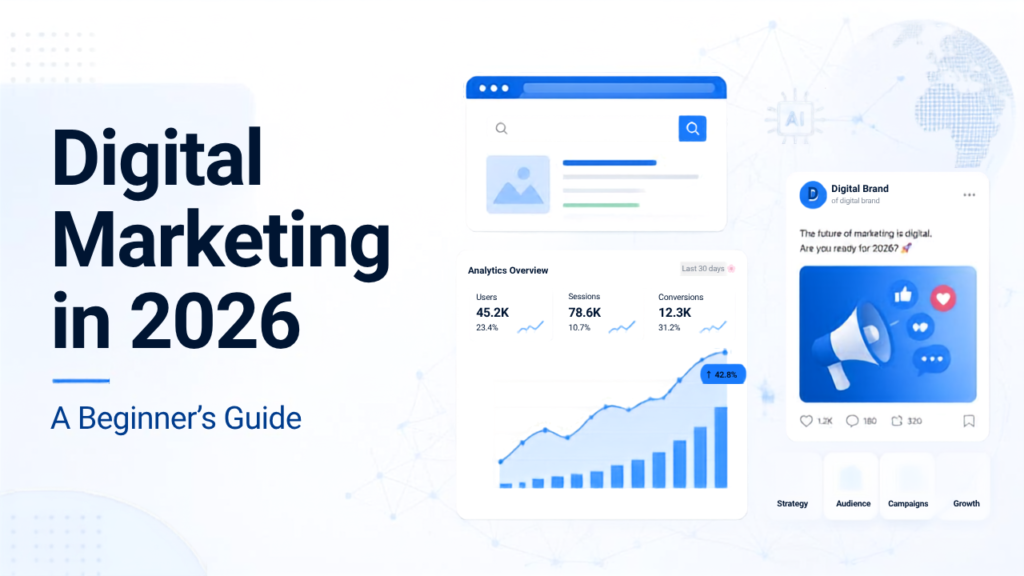
Digital marketing is now part of our everyday lives, even when we do not notice it. When you search for a nearby service on Google, discover a product through Instagram or click an online advertisement, digital marketing is working behind the scenes.
For someone new to the field, digital marketing in 2026 can seem complicated. There is SEO, social media, content marketing, paid advertising, email marketing and a growing number of AI tools to understand. You do not need to learn everything at the same time.
This beginner’s guide will help you understand the main areas of digital marketing, how they work together and what you can do to start learning them through practical experience.
What Is Digital Marketing?
Digital marketing means promoting a business, product, service or personal brand through online channels. These channels include websites, search engines, social media platforms, email, mobile apps and digital advertisements.
The main advantage of digital marketing is that its performance can be measured. A business can see how many people visited its website, viewed a post, clicked an advertisement, submitted an enquiry or purchased a product.
For example, imagine that a local interior designer wants to receive more enquiries. A digital marketing strategy could include a professional website, helpful Instagram content, local SEO and targeted advertisements. Each channel serves a different purpose, but they all work towards the same business goal.
Why Is Digital Marketing Important in 2026?
People regularly use the internet to compare products, read reviews, check prices and find nearby services. A business with a clear online presence is easier to discover and understand.
Digital marketing also allows businesses to reach a more relevant audience. Instead of showing the same message to everyone, a campaign can focus on people based on factors such as their location, interests, needs or search behaviour.
For businesses, this can support brand awareness, website traffic, customer enquiries, lead generation and sales. For individuals, it also creates career opportunities in areas such as SEO, content creation, social media management, advertising, analytics and website development.
The Main Areas of Digital Marketing
1. Search Engine Optimization
Search Engine Optimization, commonly known as SEO, is the process of improving a website so that it can appear more prominently in relevant search results.
SEO includes keyword research, useful content, clear page structure, internal links, website speed, mobile usability and technical improvements. Local SEO also helps businesses appear when people search for services in a particular location.
SEO usually takes time. It is a long-term process that requires useful content, technical quality and regular improvement. Repeating a keyword many times does not automatically improve rankings. The content must answer the reader’s question clearly and provide real value.
Why Is Digital Marketing Important in 2026?
Why Is Digital Marketing Important in 2026?
Lorem ipsum dolor sit amet, consectetur adipiscing elit. Ut elit tellus, luctus nec ullamcorper mattis, pulvinar dapibus leo.
2. Social Media Marketing
Social media marketing involves using platforms such as Instagram, Facebook, LinkedIn and YouTube to communicate with an audience.
Businesses can use social media to share knowledge, present their products, explain their services, answer questions and build familiarity with potential customers. Content may include educational posts, short videos, customer stories, product demonstrations and business updates.
Posting frequently is only one part of social media marketing. A good strategy considers the audience, content purpose, visual identity, posting schedule and desired action. Reach and likes can be useful indicators, but enquiries, website visits and conversions often provide a clearer picture of business value.
3. Content Marketing
Content marketing means creating useful information for a specific audience. Blog articles, videos, social media posts, guides, case studies and email newsletters are common examples.
Good content begins with a real question or problem. A website designer might publish an article about improving mobile website performance. A clothing brand might create a video explaining fabric quality or sizing.
Helpful content can improve visibility, demonstrate knowledge and build trust over time. It should sound natural, reflect the brand’s voice and give the reader something useful. Copying content from another website can damage credibility and create duplication problems.
Businesses can use social media to share knowledge, present their products, explain their services, answer questions and build familiarity with potential customers. Content may include educational posts, short videos, customer stories, product demonstrations and business updates.
Posting frequently is only one part of social media marketing. A good strategy considers the audience, content purpose, visual identity, posting schedule and desired action. Reach and likes can be useful indicators, but enquiries, website visits and conversions often provide a clearer picture of business value.
4. Paid Advertising
Paid advertising allows businesses to pay for visibility on platforms such as Google, Facebook and Instagram.
Google Ads can help a business reach people who are already searching for a product or service. Meta Ads can introduce a business to people based on interests, location, behaviour and other audience signals.
Every campaign should begin with a clear objective. This may be generating leads, receiving messages, increasing website visits or producing sales. The campaign also needs suitable creative content, a relevant landing page, accurate tracking and a controlled budget.
Running an advertisement without measuring enquiries or sales makes it difficult to understand whether the money produced a useful result.
Good content begins with a real question or problem. A website designer might publish an article about improving mobile website performance. A clothing brand might create a video explaining fabric quality or sizing.
Helpful content can improve visibility, demonstrate knowledge and build trust over time. It should sound natural, reflect the brand’s voice and give the reader something useful. Copying content from another website can damage credibility and create duplication problems.
Businesses can use social media to share knowledge, present their products, explain their services, answer questions and build familiarity with potential customers. Content may include educational posts, short videos, customer stories, product demonstrations and business updates.
Posting frequently is only one part of social media marketing. A good strategy considers the audience, content purpose, visual identity, posting schedule and desired action. Reach and likes can be useful indicators, but enquiries, website visits and conversions often provide a clearer picture of business value.
5. Email Marketing
Email marketing helps businesses communicate directly with people who have chosen to receive updates.
Businesses can use email to share educational content, product announcements, offers, event information and follow-up messages. A useful email normally has a clear subject line, focused content and one main call to action.
Unlike a social media audience, an email list gives a business a more direct way to maintain customer relationships. However, businesses should obtain permission before sending promotional emails and make it easy for recipients to unsubscribe.
6. Website Design and Development
A website is often the centre of a business’s digital presence. Search results, advertisements, emails and social media posts can all direct potential customers to it.
A professional website should clearly explain what the business offers, who it serves and how a visitor can take the next step. It should load quickly, work well on mobile devices and make important information easy to find.
An attractive design can create a good first impression, but usability is equally important. Visitors should not struggle to find services, contact details or enquiry options. Good website design brings visual presentation, user experience, content and SEO together.
How AI Is Changing Digital Marketing
Artificial intelligence has become a useful part of digital marketing. Marketers now use AI tools for research, brainstorming, content planning, data analysis, customer support and advertising optimization.
These tools can reduce the time needed for repetitive work, but their output still needs human review. AI can produce incorrect facts, generic writing or ideas that do not suit the audience. Publishing the first output without checking it can weaken the quality of a brand’s communication.
AI works best as an assistant. A marketer still needs to understand the business, identify the audience, choose the right message and review the final result. Creativity, judgement and communication remain valuable skills.
How to Start Digital Marketing in 2026
You can begin learning digital marketing without trying to master every channel at once. Start by understanding the basic purpose of SEO, social media, content, paid advertising, email and websites.
After learning the fundamentals, choose one or two areas that match your interests. If you enjoy writing and research, content marketing and SEO may be suitable. If you enjoy visual communication and audience interaction, social media marketing may be a better starting point. If you are interested in data and campaign performance, you may prefer paid advertising or analytics.
The next step is practical work. Create a simple website, publish original articles, manage a social media page or help a small business with a clearly defined task. Practical projects teach you how planning, execution and measurement work together.
Document each project honestly. Explain the objective, the work completed, the tools used and the outcome. A small project with clear evidence is more valuable than an impressive claim that cannot be supported.
A Simple Digital Marketing Strategy for Beginners
Step 1: Set a Clear Goal
Decide what you want the marketing activity to achieve. The goal could be increasing website traffic, receiving enquiries, generating leads, improving brand awareness or producing sales. A clear goal makes it easier to choose the right channel and measure progress.
Step 2: Understand the Audience
Identify who is most likely to need the product, service or information. Consider their location, interests, problems, online behaviour and preferred platforms. Marketing becomes more effective when the message is created for a specific audience.
Step 3: Choose the Right Channels
Select the platforms that support the goal and match the audience. A local service business may benefit from Google Search, local SEO and a professional website. A visually focused brand may find Instagram and short-form video more useful.
Step 4: Create Useful Content
Create content that answers questions, explains the value of the business or helps the audience make a decision. Each article, post or video should have a clear purpose and a natural call to action.
Step 5: Measure and Improve
Review the results and identify what is working. Website visits, search impressions, engagement, enquiries, leads and conversions can provide useful information. Use this information to improve the next piece of content or campaign.
Important Digital Marketing Metrics
Digital marketing provides access to a large amount of data, but every number is not equally important. The right metrics depend on the original goal.
Some useful metrics include:
• Website traffic
• Search impressions
• Search rankings
• Click-through rate
• Social media reach
• Engagement rate
• Leads and enquiries
• Conversion rate
• Cost per lead
• Return on advertising spend
For example, a post may receive many likes without generating any website visits or enquiries. This does not make the post useless, but it shows why performance should be judged using metrics connected to the actual goal.
Common Mistakes Beginners Should Avoid
One common mistake is trying to learn every platform and tool at the same time. This often creates confusion and makes practical progress difficult.
Beginners should also avoid copying content, repeating keywords unnaturally, publishing unchecked AI writing and focusing only on followers or likes. Other mistakes include running advertisements without tracking, ignoring mobile website performance and expecting immediate SEO results.
Digital marketing involves testing and improvement. Some ideas will perform well, while others will provide lessons for the next attempt. Paying attention to the results is an important part of developing real ability.
Essential Skills for a Digital Marketing Beginner
A beginner can gradually develop skills in audience research, content writing, SEO, social media management, basic design, paid advertising, analytics and website management.
Communication and strategic thinking are also important. A marketer needs to understand the business problem, explain ideas clearly and connect marketing activities with meaningful goals.
Basic technical knowledge can be an advantage when working with websites, SEO, analytics and tracking. However, progress comes from combining knowledge with consistent practical work.
For more Digital Marketing insights check www.santhwin.com